 Forward Future
China Steps In After the CSI 300's Worst Month in a Decade
2026-11-02
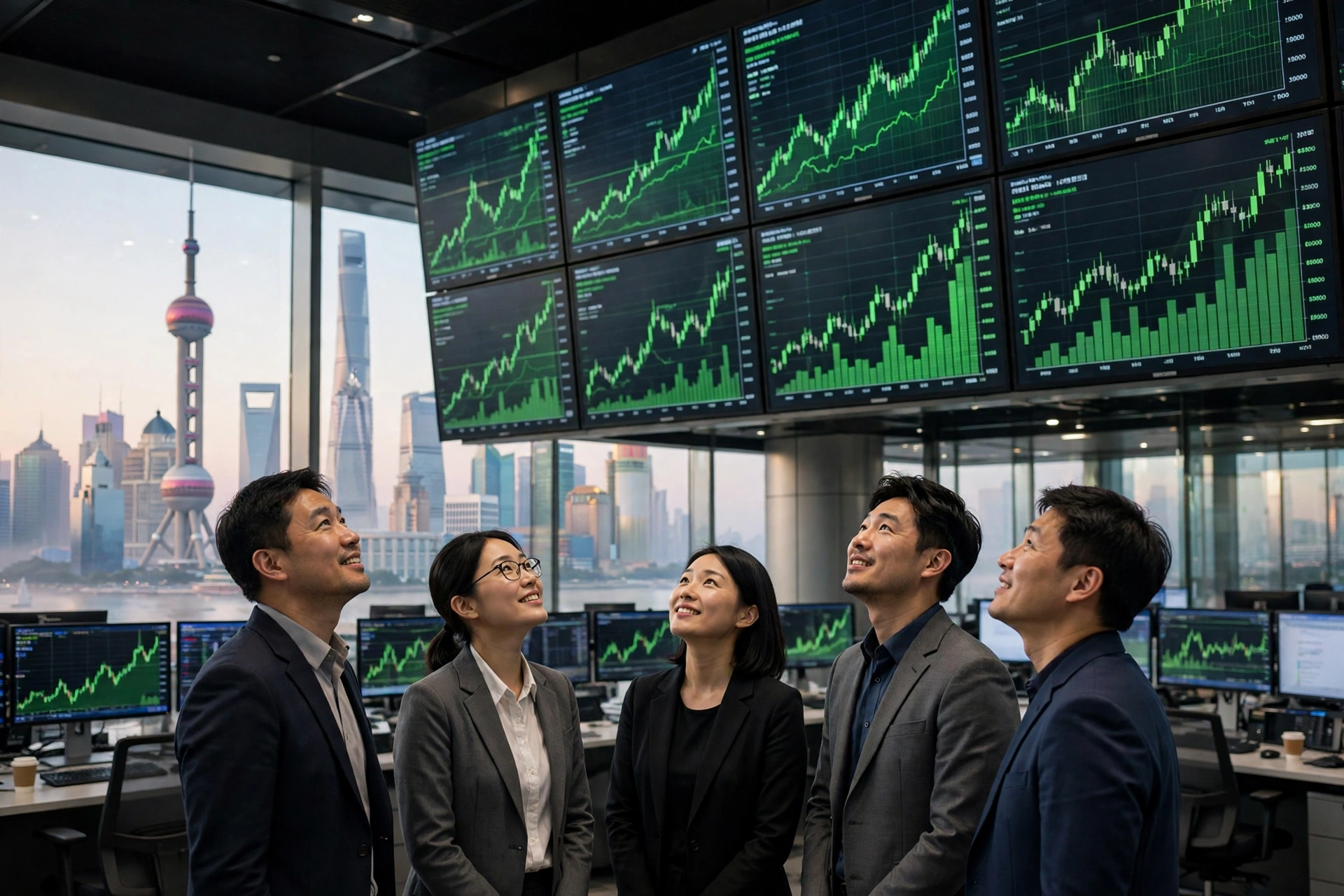
China's top financial regulators met banks and securities firms on Monday, November 2, to discuss new tools to support the stock market — and Chinese shares rallied hard, with the Shanghai Composite up about 1.2%, Shenzhen up 2.4% and the ChiNext up 3.3% by the midday break. The meeting follows the CSI 300's 8.5% slump in October, its worst month in more than a decade.
What happened, in one answer
Local media reported that the People's Bank of China (PBOC), the National Financial Regulatory Administration, the China Securities Regulatory Commission and major banks would meet on Monday to study improving a relending programme that funds share buybacks and stake increases by listed companies. In plain terms, Beijing is looking at making it easier and cheaper for companies to buy their own shares — one of the most direct ways to put a floor under a falling market. Reuters reported the talks as turbulence in stocks and bonds fuelled calls for policy support.
Why it's blowing up now
The timing is the story. Chinese benchmarks started November hovering near their lowest levels in more than a year after a record 12-week slide. The CSI 300 lost 8.5% in October alone. Stabilisation efforts launched last month have not yet reversed the downturn, and weak demand data keeps adding pressure: official manufacturing PMI fell to 49.3 in October from 50.1 in September — back in contraction — while the non-manufacturing gauge slipped to 49.7, its sixth contraction reading this year.
There was one brighter data point on Monday. The private RatingDog manufacturing PMI held at 52.0, beating expectations, with output growth at its fastest since April. That survey leans toward export-oriented firms, so the picture is split: exporters are still growing, while the broader domestic economy is shrinking.
The central bank moved on rates, too
Alongside the meeting, the PBOC began daily overnight reverse repo operations at a fixed rate of 1.25% — below the 1.4% seven-day rate. Analysts read that as a step toward making the overnight rate the central bank's main policy anchor, in a style closer to the US Federal Reserve. Cheaper overnight money does not fix weak demand on its own, but it signals that liquidity support is now a daily tool, not an occasional one.
How markets reacted across Asia
The relief spread well beyond China. South Korea's KOSPI led regional gains, up about 2.8% in later trading after opening down 1.62% at 5,637.77 on fears of a 'Black Monday' after Friday's US tech rout. SK hynix recovered to trade up about 1.9%, and institutional investors were net buyers even as foreign and retail investors sold. Hong Kong's Hang Seng rose about 0.6% and Japan's Nikkei about 0.4%. Inside China, CATL gained about 1.7% and Wuliangye Yibin about 3.4% in early trade, while big state banks such as Agricultural Bank of China and Bank of China fell about 1% — a rotation into growth names rather than a blanket rally.
What to watch next
Three things will decide whether this bounce lasts. First, what the regulators actually announce: an expanded or cheaper buyback relending facility would be concrete support, while a meeting with no follow-through would fade fast. Second, whether the CSI 300 can hold above its recent lows after losing 8.5% in a month. Third, the data split — if the official PMI stays below 50 while private surveys hold up, Beijing may face pressure for broader stimulus beyond market tools. None of this is a buy or sell signal; it is a policy story still being written, and Monday's gains are a reaction to expected support, not confirmed results.
FAQ
Why did Chinese stocks rally on Monday?
Reports that the PBOC, financial regulators and major banks would meet to discuss improving a relending programme for share buybacks lifted sentiment after the CSI 300's worst month in more than a decade.
How much did the CSI 300 fall in October?
The benchmark CSI 300 slumped 8.5% in October 2026, described as its worst month in more than a decade, and Chinese benchmarks began November near their lowest levels in over a year.
What is the buyback relending programme?
It is a central-bank facility that lends to banks so they can fund listed companies' share buybacks and stake increases — a tool designed to support share prices directly.
What did the PBOC change on rates?
The PBOC began daily overnight reverse repo operations at a fixed 1.25%, below the 1.4% seven-day rate, a step toward making the overnight rate its main policy anchor.
Sources
- Reuters via TradingView — Chinese regulators hold talks on market support tools
- investingLive — Asia-Pacific market news, China rally and PBOC daily repo
- CNBC-TV18 via TradingView — Asian equities and the regulator meeting
- TradingView — China stocks start November near 2025 lows, PMI data
- Aju Press — KOSPI rebounds after opening down 1.62%