 Forward Future
KOSPI Crashes Over 5%: Sidecars Fire as Samsung and SK hynix Plunge
2026-11-05
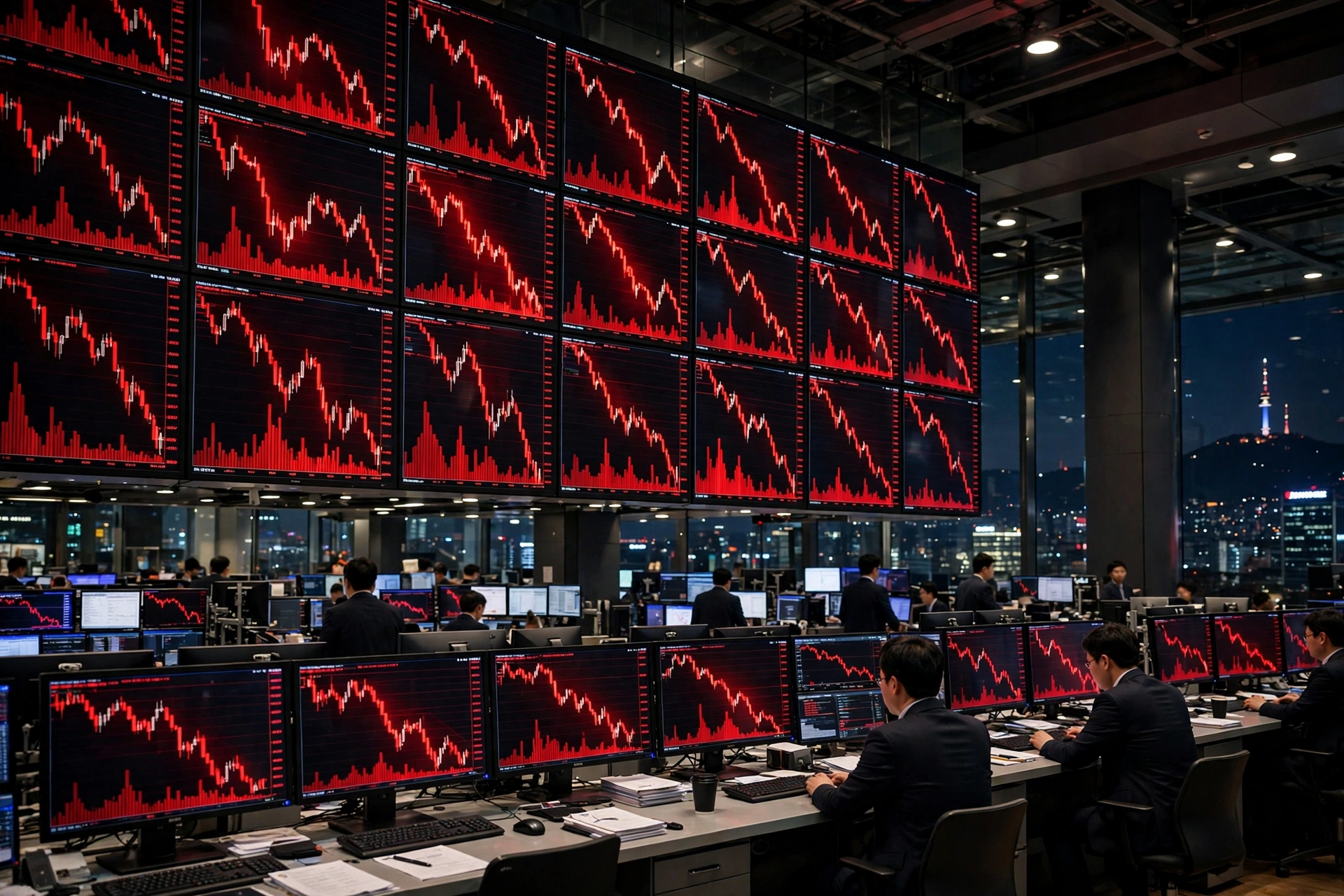
South Korea's KOSPI fell more than 5% on Thursday, November 5, 2026, triggering emergency sell-side sidecars on both the KOSPI and KOSDAQ, as Samsung Electronics and SK hynix plunged on fears that a Democratic sweep in the U.S. midterms will bring tighter rules for AI data centres. By mid-afternoon in Seoul the benchmark was down 5.25% at 5,385.26, after sliding as low as 5,386.29 earlier in the session.
What happened in Seoul?
The KOSPI opened 1.82% lower at 5,580.09 and the selling quickly deepened. At 10:16 a.m. local time the Korea Exchange activated a sell-side sidecar on the KOSPI market, suspending program sell orders for five minutes after KOSPI 200 futures stayed down more than 5% for a full minute. It did not stop the slide. By 2:29 p.m. the KOSPI was down 298.54 points, or 5.25%, and the smaller KOSDAQ was down 4.84% at 680.35. The KOSDAQ then triggered its own sell-side sidecar at 2:27 p.m., its first since October 15, when KOSDAQ 150 futures fell more than 6% while the index dropped more than 3%.
A sidecar is not a full halt. Normal trading continues, but program selling pauses for five minutes — a speed bump to slow feedback loops when futures move too fast.
Which stocks were hit hardest?
Chipmakers led the fall, because Korea's index is unusually heavy in semiconductors. At 2:37 p.m., Samsung Electronics was down 7.57% at 201,500 won and SK hynix was down 9.38% at 1,265,000 won. Samsung Electro-Mechanics plunged 14.62%, SK Square fell 10.57% and Samsung Electronics preferred shares dropped 6.23%. Earlier snapshots told the same story in stages: Samsung down about 5% and SK hynix down about 7% in the morning, then SK hynix down 8.60% to 1.276 million won by 1 p.m.
Foreign investors drove the selling. By 1 p.m. foreigners had sold a net 1.97 trillion won on the main board, while retail investors bought a net 1.48 trillion won and institutions bought 304.2 billion won, absorbing part — but not all — of the supply.
Why is it blowing up?
The trigger came from the United States, twice over. First, U.S. chip stocks had already fallen hard on Wednesday: the Philadelphia Semiconductor Index dropped 3.13%, reflecting uncertainty over AI infrastructure spending. Second, Democrats won control of both chambers of Congress in the November 3 midterms, and investors in Seoul read that result as raising the odds of stricter regulation of AI data centres — including rules on construction, power use and permitting.
That matters for Korea: Samsung and SK hynix supply the memory chips AI data centres depend on, so any expected slowdown in building lands first on their shares. Reuters saw the same pattern across Asia — chip stocks and oil under pressure while most other stocks rose. In Tokyo, Kioxia slumped about 10%, Taiwan fell, and Hong Kong and Shanghai rose as investors rotated out of AI names.
This was not a Korea-specific earnings shock. It was a global repricing of the AI build-out, concentrated in the market most exposed to it.
Key facts
- Index: KOSPI down 5.25% at 5,385.26 by 2:29 p.m. Seoul time, with an intraday low near 5,386 earlier; KOSDAQ down 4.84% at 680.35.
- Sidecars: KOSPI sell-side sidecar at 10:16 a.m.; KOSDAQ sell-side sidecar at 2:27 p.m., its first since October 15.
- Leaders down: SK hynix -9.38%, Samsung Electronics -7.57%, Samsung Electro-Mechanics -14.62% in mid-afternoon trade.
- Flows: Foreign net selling reached 1.97 trillion won on the main board by 1 p.m.
- U.S. lead-in: Philadelphia Semiconductor Index -3.13% on Wednesday.
What's next?
Traders will watch whether U.S. chip stocks stabilise when Wall Street opens on Thursday, whether foreign selling slows after a 5% day, and what Democratic leaders actually propose on data centres — reporting so far stresses most analysts expect at most a temporary slowdown in AI demand, not an end to it. Until that picture clears, Korea's chip-heavy market will stay the world's loudest amplifier of the AI trade, in both directions. This report describes what happened and why markets reacted; it is not a recommendation to buy, sell or hold any security.
Sources
Reuters — Oil and data centre stocks sink after US midterms
Morningstar / Dow Jones Newswires — Oil extends decline, Asian stocks mixed
Seoul Economic Daily — KOSPI slides as blue wave hits chip stocks
Seoul Economic Daily — KOSDAQ triggers sell-side sidecar
Money Today — Blue wave triggers market rout, sidecars fire in turn
FAQ
How much did the KOSPI fall on November 5, 2026?
It fell more than 5% intraday, trading down 5.25% at 5,385.26 by 2:29 p.m. in Seoul, with Samsung Electronics and SK hynix leading the decline.
What is a sell-side sidecar?
It is a Korea Exchange stabilisation tool that suspends program sell orders for five minutes when index futures fall sharply — more than 5% for KOSPI 200 futures — and stay there for one minute. Normal trading continues.
Why did Korean chip stocks fall so hard?
U.S. chip stocks fell 3.13% on the Philadelphia Semiconductor Index, and the Democratic midterm sweep raised fears of tighter AI data-centre rules, which would directly affect demand for Samsung and SK hynix memory chips.
Did both Korean markets trigger sidecars?
Yes. The KOSPI triggered a sell-side sidecar at 10:16 a.m., and the KOSDAQ followed at 2:27 p.m., its first sidecar since October 15.