 Forward Future
KOSPI Opens Lower as Kioxia Plunges 12% in Tokyo
2026-11-01
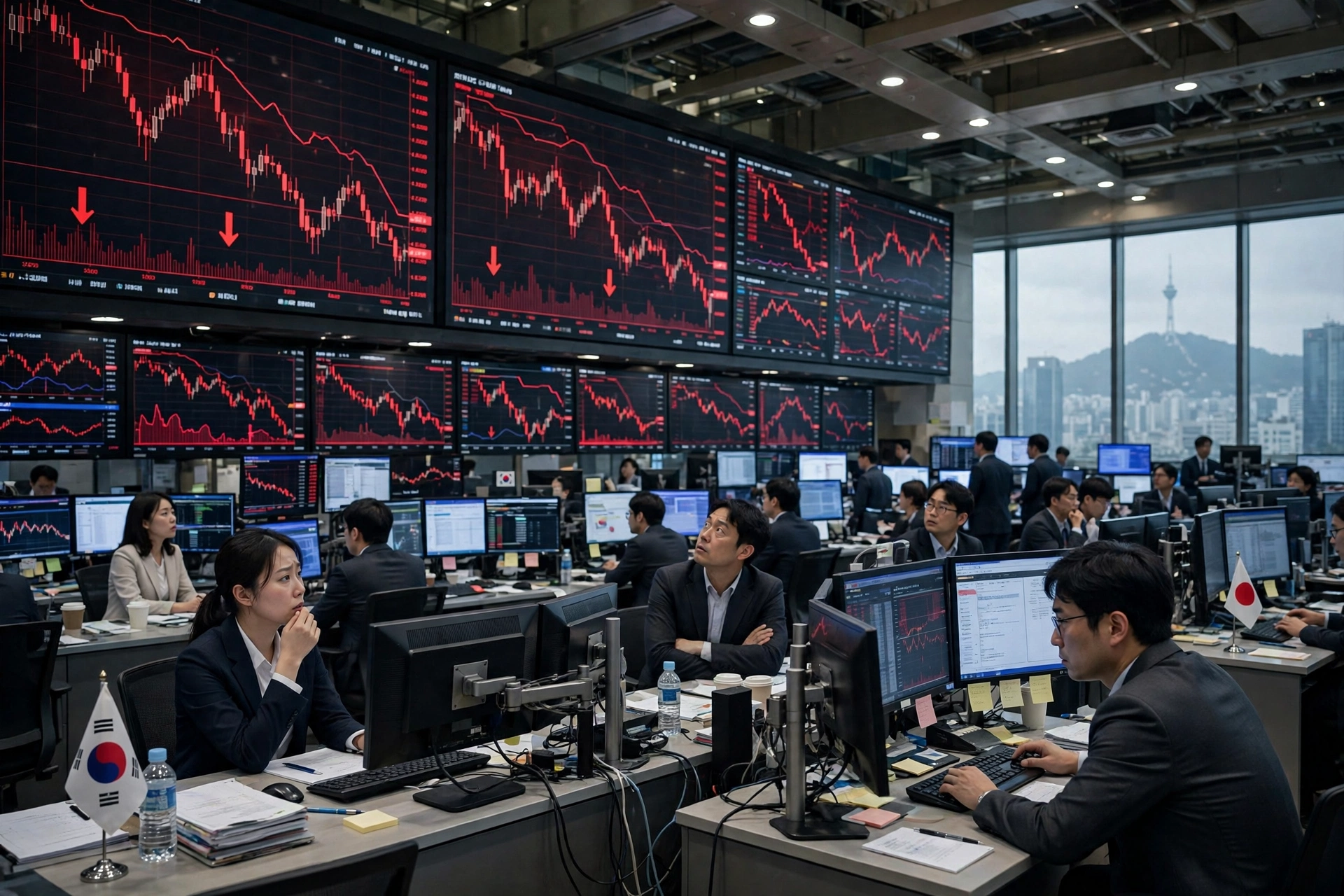
South Korea's KOSPI opened sharply lower on Monday, November 2, falling 1.62% at the open, while Japan's Nikkei 225 slipped 0.33% and chipmaker Kioxia plunged 12.36% — as Asia extended Friday's Wall Street sell-off over AI spending worries ahead of Tuesday's U.S. midterm elections.
What happened, in one answer
Seoul stocks opened lower on Monday, weighed down by declines in U.S. tech shares amid concerns over massive investments in artificial intelligence, Yonhap reported. The benchmark Korea Composite Stock Price Index (KOSPI) opened down 92.97 points, or 1.62 percent, to 5,637.77, and was still down 51 points, or 0.89 percent, to 5,679.74 as of 9:15 a.m. local time. In Tokyo, the Nikkei 225 fell 0.33% to 63,082.53 in early trade, according to TradingKey.
Why it is blowing up now
The move is a direct follow-through from Friday in the United States. Major indexes on Wall Street closed lower on Friday following disappointing quarterly earnings from Intel and Amazon, which amplified growing concerns over the sustainability of AI spending, Yonhap said. The S&P 500 fell 1.82 percent and the tech-heavy Nasdaq declined 2.86 percent in that session. Because Samsung Electronics and SK hynix sit at the centre of the global AI memory trade, a U.S. tech sell-off driven by AI spending questions lands in Seoul first when Asia opens — and that is what Monday's open showed.
The key facts
The chips led the fall in Seoul. Chip giants Samsung Electronics and SK hynix fell 2.89 percent and 0.63 percent, respectively, by 9:15 a.m., Yonhap reported. TradingKey, looking at a slightly later snapshot, put Samsung down 3%, breaching the 220,000 won mark to trade at 218,500 won, and SK hynix down 1.4%, losing the 1.4 million won level to trade at 1,399,000 won. The different percentages reflect different times in a fast-moving opening session, not different stories.
The selling was broad, not just chips. Battery maker LG Energy Solution retreated 0.76 percent, carmaker Hyundai Motor slid 0.18 percent, and financial firm KB Financial dipped 2.77 percent, according to Yonhap. The Korean won was trading at 1,335.2 won against the U.S. dollar as of 9:15 a.m., down 0.9 won from the close of the previous session.
Tokyo fell less, but one chip name crashed. The Nikkei 225's 0.33% fall to 63,082.53 was milder than Seoul's drop, TradingKey reported, but memory maker Kioxia plunged 12.36% to 11,805 yen and SoftBank fell 3.19% to 4,338 yen. That pattern — a modest index fall hiding a very large fall in one AI-linked name — mirrors what happened in the U.S. on Friday, where headline index losses understated the damage in individual tech stocks.
Politics is part of the caution. Investors are also closely following the U.S. jobs report and the U.S. midterm elections set to take place on Tuesday, Yonhap said. TradingKey described Monday's gap-down open in Japan and South Korea as a classic pre-election risk-averse move, with traders waiting to see the election outcome before committing fresh capital. On the Middle East front, Iranian negotiators were in Doha on Sunday for a third consecutive day of talks with Qatari mediators aimed at ending the U.S.-Iran war, Yonhap added — a separate factor that has been moving oil and broader risk sentiment.
What this means for the week
Asia's Monday open does not settle the AI spending debate; it passes it back to the United States. Apple and Palantir report on Monday in the U.S., AMD reports on Tuesday, and Friday brings the October jobs report — each of those can either calm or deepen the concern that drove Friday's sell-off and Monday's Asian falls. For Seoul in particular, the question is whether Samsung and SK hynix stabilise once U.S. trading resumes, because the KOSPI's direction this week is likely to follow the same AI names that pulled it down at the open. This report describes what happened and why markets reacted; it is not a recommendation to buy, sell or hold any security.
Sources
Yonhap via K-VIBE — Seoul stocks open lower, KOSPI down 1.62% at the open
TradingKey — KOSPI drops over 1%, Kioxia plunges 12%, Samsung and SoftBank fall 3%
TokenPost — South Korea's KOSPI opens 1.62% lower as Samsung shares fall
FAQ
Why did the KOSPI fall on Monday, November 2?
The KOSPI fell because U.S. tech shares dropped sharply on Friday after disappointing Intel and Amazon earnings raised concerns about the sustainability of massive AI spending, and Seoul's chip-heavy index followed that sell-off at Monday's open.
How much did Samsung Electronics and SK hynix fall?
By 9:15 a.m. in Seoul, Samsung Electronics was down 2.89 percent and SK hynix was down 0.63 percent, according to Yonhap; a later TradingKey snapshot put Samsung down about 3% below 220,000 won.
Why did Kioxia plunge 12% in Tokyo?
Kioxia fell 12.36% to 11,805 yen in early Tokyo trade as investors sold AI-linked chip names across Asia following Friday's U.S. tech sell-off, even though the broader Nikkei 225 fell only 0.33%.
What are investors watching next this week?
Investors are watching Tuesday's U.S. midterm elections, the U.S. jobs report on Friday, and U.S. earnings from Apple, Palantir and AMD, which will test whether AI spending concerns deepen or ease.