 Forward Future
KOSPI's V-Shaped Rebound: From -1.6% to +2.5% as 'Black Monday' Fears Fade
2026-11-02
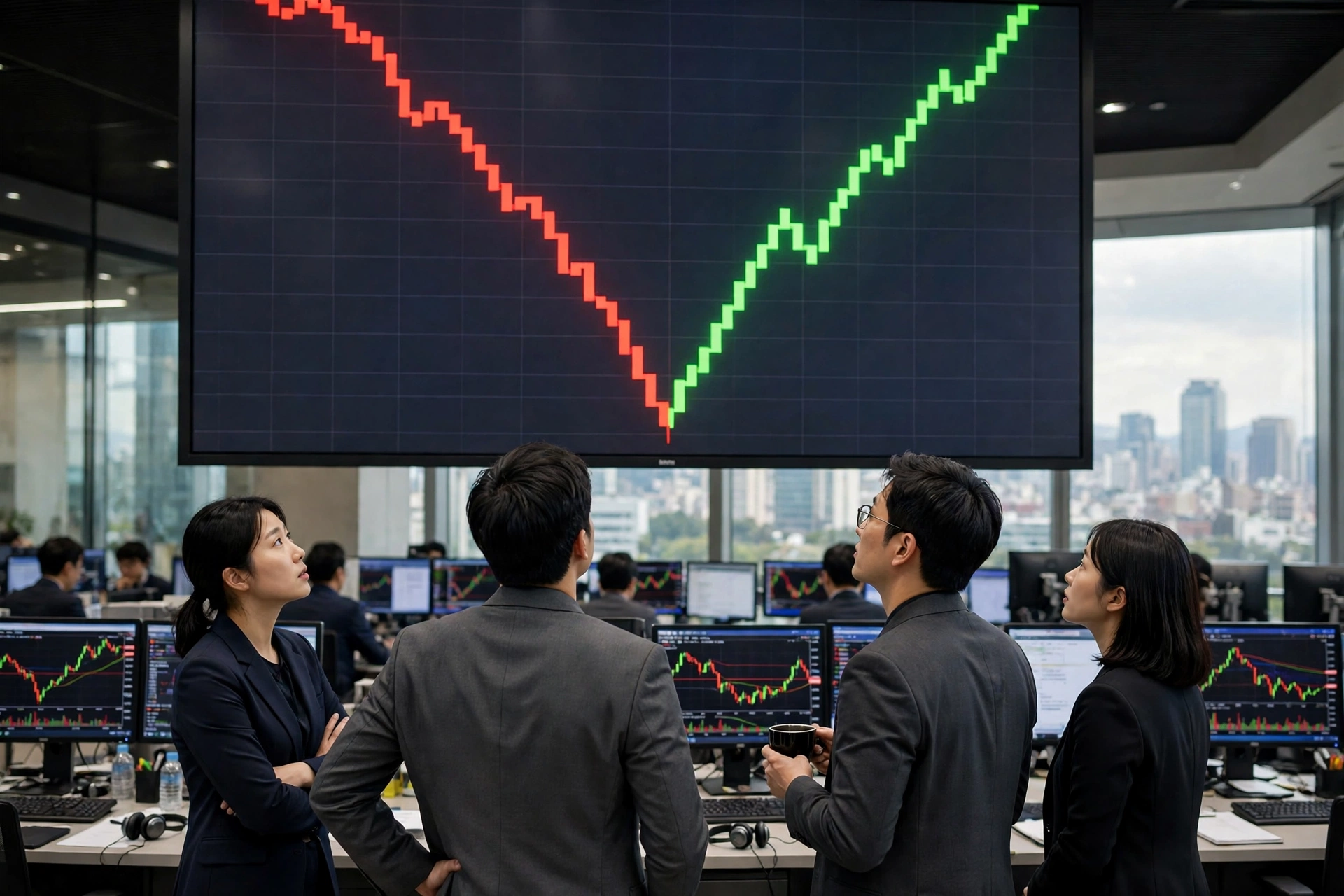
South Korea's KOSPI opened down 1.62% on Monday, November 2, then reversed to trade up 2.46% by early afternoon — a V-shaped rebound driven by 1.21 trillion won of institutional buying that erased fears of a 'Black Monday' after Friday's U.S. chip rout.
What happened
The KOSPI opened at 5,637.77, down 92.97 points or 1.62% from Friday's close of 5,730.74, according to Korea Exchange data reported by Aju Press. By 11:20 a.m. in Seoul it was up 1.63% at 5,823.9, Yonhap reported, as bargain hunters bought technology heavyweights. By 2:05 p.m. it had climbed further to 5,871.56, up 140.82 points or 2.46%, and a Dow Jones update carried by Morningstar put the index 2.9% higher in later trading.
The junior KOSDAQ followed the same path. After opening lower, it was up 8.24 points, or 1.14%, at 732.62 at 2:05 p.m., Aju Press reported.
Why it is blowing up
The open looked like the start of another rout. On Friday in the United States, Intel fell 28.58% after a disappointing outlook, the Philadelphia Semiconductor Index plunged 7.2%, and the Nasdaq Composite lost 2.86%. The KOSPI itself had fallen 3.48% on October 30 and, as Reuters noted, had shed about 16% in October. Traders in Seoul went into Monday braced for what local coverage called 'Black Monday' fears.
Instead, the selling was absorbed within the first hour. Institutions were the buyers. They net bought 464.4 billion won on the main board by 10:10 a.m., and that total had risen to 1.2114 trillion won by early afternoon, Aju Press reported, even as foreign and individual investors were net sellers in the morning. That scale of domestic institutional buying is why the move is being shared as a reversal, not just a bounce: the index did not drift back to flat, it pushed through 5,800 and kept rising into the afternoon.
Key facts
- Open: 5,637.77, down 1.62% from 5,730.74.
- Afternoon level: 5,871.56 at 2:05 p.m., up 2.46%; a later Dow Jones update put the KOSPI 2.9% higher.
- Chip leaders: Samsung Electronics rose 2.00% and SK Hynix rose 4.37% by early afternoon, while SK Square surged 5.69%.
- Drivers: Institutions net bought 1.2114 trillion won; Hyundai Motor rose 1.42%, while LG Energy Solution fell 1.95%, Samsung Biologics fell 2.82% and KB Financial fell 1.48%.
- Regional picture: Hong Kong's Hang Seng rose 0.6% and China's Shanghai Composite rose 0.7% in the same Dow Jones update, while Japan's Nikkei edged down 0.1%.
Why chips led the turn
Semiconductors are the KOSPI's centre of gravity, so a U.S. chip selloff hits Seoul first — and a recovery has to start there too. SK Hynix had fallen as much as 2.05% early on and Samsung Electronics as much as 3.56%, according to regional reporting of the morning session, before both turned higher. By early afternoon their gains, alongside SK Square, were doing most of the work in lifting the index. That matters because Friday's fear was specific: that huge artificial-intelligence spending would not pay off fast enough. Monday's buying does not settle that argument, but it shows local institutions were willing to buy the sector at lower prices rather than wait for another U.S. session to decide.
What's next
The test comes tonight and tomorrow. Apple and Palantir report in the United States on Monday after the close, AMD reports Tuesday, and U.S. midterm elections are held Tuesday — all events Seoul traders cited as reasons for caution before the open. If U.S. technology shares stabilise, Monday's rebound will look like bargain hunting that worked. If they fall again, the KOSPI's morning low of 5,637.77 is the level traders will watch first. For now, the verified story is narrower and still striking: a market that opened braced for a rout closed the morning in the green and extended the gain in the afternoon, led by the very chip stocks that caused the fear.
This report describes what happened in the market; it is not a recommendation to buy, sell or hold any security.
Sources
- Aju Press — KOSPI recovers with 2% surge driven by institutional buying
- Morningstar / Dow Jones Newswires — Asian stocks mostly higher as risk-off sentiment eases
- Yonhap via Korean-Vibe — Seoul stocks turn up late Monday morning on bargain hunting
- Aju Press — KOSPI rises nearly 1% despite Wall Street chip rout
FAQ
How much did the KOSPI move on November 2?
It opened down 1.62% at 5,637.77, was up 1.63% by 11:20 a.m., and was up 2.46% at 5,871.56 by 2:05 p.m., with a later Dow Jones update putting it 2.9% higher.
What caused the rebound?
Institutional buying. Institutions net bought 1.2114 trillion won by early afternoon, lifting chip heavyweights Samsung Electronics and SK Hynix after Friday's U.S. semiconductor selloff.
Why were investors worried before the open?
Intel fell 28.58% in the United States on Friday, the Philadelphia Semiconductor Index fell 7.2%, and the KOSPI had already fallen 3.48% on October 30, raising 'Black Monday' fears in Seoul.
Did other Asian markets rebound too?
Mostly yes. The Hang Seng rose 0.6% and the Shanghai Composite rose 0.7% in the Dow Jones update, while Japan's Nikkei edged down 0.1%.