 Forward Future
Sensex Reclaims 80,000 for First Time Since March as India Defies Global Rout
2026-11-06
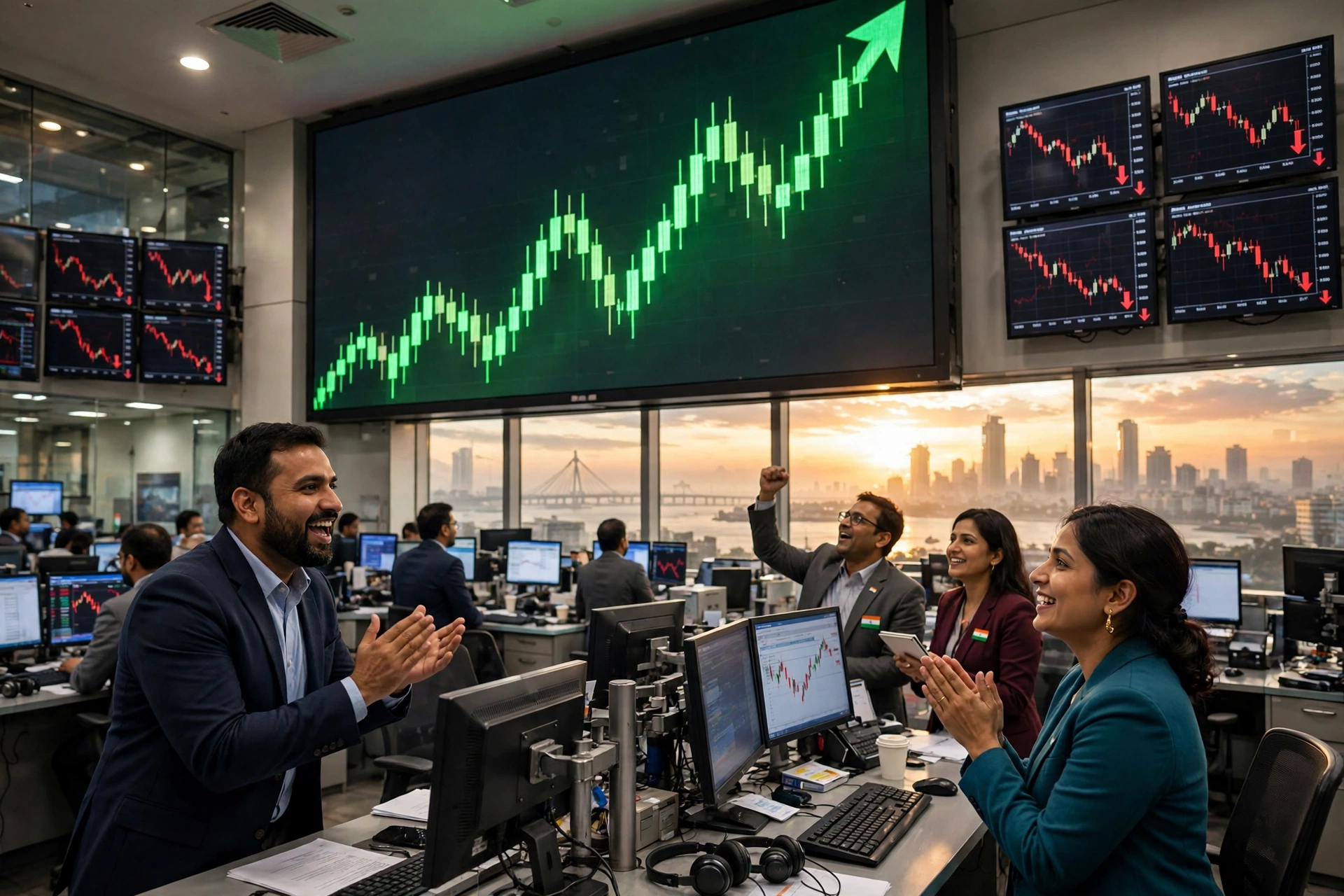
The Sensex is back above 80,000. India's benchmark index crossed that psychological level in intraday trade on Friday, November 6, 2026, for the first time since March 5 — even as a global sell-off in artificial intelligence and semiconductor stocks hammered markets from Tokyo to New York. While Japan and South Korea plunged, Indian shares extended their winning run to a seventh straight session, powered by buying in banks and financial stocks and a sustained return of foreign investors.
What happened
The BSE Sensex closed Thursday at 79,310.01, then pushed through 80,000 on Friday morning in Mumbai. By 1:11 p.m. local time it had touched an intraday high of 80,080.59 and was trading at 80,027.74, up 717.73 points or 0.90%, according to The Hindu BusinessLine. The Nifty 50 rose alongside it, gaining 161.60 points or 0.66% to 24,698, with an intraday high of 24,702.60.
The rally strengthened through the afternoon. At 2:08 p.m., Upstox reported the Sensex at 80,388.26, up 1,078.25 points or 1.36%, after a session high of 80,512.92, with the Nifty at 24,747.40. By 2:36 p.m., DSIJ put the Sensex at 80,540.11, up 1,230.10 points or 1.55%, and the Nifty at 24,857.60, up 321 points or 1.31%. These are intraday readings from a live session, not closing prices.
The milestone matters because of how long it has been absent. BusinessLine notes the Sensex last touched this territory on March 5, 2026, when it closed at 80,015.90, before slipping into an eight-month correction. Reclaiming 80,000 therefore marks the end of that long climb back, at least on an intraday basis.
Why it is blowing up
The contrast with the rest of the world is what made Friday's move go viral among market watchers. On Thursday, the Nasdaq Composite plunged 5.52%, the S&P 500 fell 4.36% and the Dow dropped about 3.45% as investors fled AI and chip stocks after the U.S. midterm results raised fears of tighter rules on data centres. In Asia on Friday, Japan's Nikkei 225 plunged around 5.9% and South Korea's Kospi lost more than 8.5%, briefly triggering a circuit breaker, according to BusinessLine's live market coverage.
India moved the other way. Traders and commentators shared the 80,000 print widely precisely because it broke an eight-month ceiling on the worst global day in months — a domestic rally standing out against a sea of red screens elsewhere.
Key facts
Who led the rise? Buying in banking and financial services stocks led the afternoon advance, Upstox reported. Among individual Nifty names, Mahindra & Mahindra was an early leader, rising 3.55% to 3,238.50 rupees, BusinessLine reported.
What about foreign money? Foreign institutional investors were net buyers for a fifth consecutive session and purchased equities worth 14,974 crore rupees, according to IANS reporting carried by hi INDiA. That sustained inflow, during the festive season, has been a central support for the seven-session run.
How big was Thursday's setup? Friday built on an already strong Thursday, when the Sensex surged 2,009 points as oil prices plunged and foreign buying returned. In other words, 80,000 was not a one-day spike from nowhere — it was the top of a week-long recovery.
Is India insulated from the AI rout? Not fully, and Friday's resilience should not be read that way. Indian technology shares still trade in a global market, and a deeper global sell-off could spill over. What Friday showed is relative strength — banks, financials and domestic demand stocks carried the index while the global selling was concentrated in AI hardware and data-centre names.
What's next
The first question is simple: can the Sensex close, and then hold, above 80,000? An intraday reclaim is a milestone; a close above the level would be a stronger signal that the eight-month correction is over. The second question comes from outside India. The U.S. October jobs report, due Friday morning U.S. time, and any further fallout from the global AI sell-off will set the tone for Monday's open in Mumbai. If foreign inflows continue for a sixth session and global markets stabilise, the rally has support. If the rout deepens, even a resilient market will be tested. This report describes what happened in the market; it is not a recommendation to buy, sell or hold any security.
FAQ
When did the Sensex last trade above 80,000 before Friday?
On March 5, 2026, when it closed at 80,015.90, according to BusinessLine. Friday, November 6 was its first intraday return to that level since then.
How high did the Sensex go on Friday, November 6?
It crossed 80,000 in the morning, touched 80,512.92 by early afternoon, and was reported at 80,540.11 at 2:36 p.m. local time — intraday figures, not a closing price.
Why did Indian stocks rise while Asian markets crashed?
Buying in banks and financials and a fifth straight session of foreign investor buying supported India, while the global sell-off was concentrated in AI, chip and data-centre stocks centred on Japan, South Korea and the United States.
How did the Nifty 50 perform?
The Nifty rose with the Sensex, reaching 24,857.60 by 2:36 p.m. local time, up 321 points or 1.31% in DSIJ's afternoon snapshot.