 Forward Future
Tesla's New Roadster Drove Upside Down and Flipped Through the Air — Here's What Actually Happened
2026-10-16
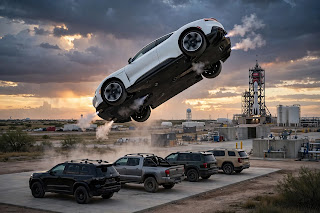
Short answer: Tesla unveiled its redesigned Roadster on October 15, 2026, at SpaceX's test site in McGregor, Texas — and the car drove upside down, flipped in mid-air, and leaped over other vehicles using a fan suction system and SpaceX cold-gas thrusters. Tesla says production is planned for 2028.
What happened at the Tesla Roadster demo?
For almost nine years, the second-generation Tesla Roadster was the car that kept not arriving. Tesla first showed it in 2017 and originally expected deliveries to begin in 2020. On Thursday night in McGregor, it finally returned — not with a quiet spec sheet, but with a stunt show.
According to multiple reports of the livestreamed event, the white two-seater drove up a curved ramp and hung upside down, held in place by a fan-powered suction system underneath the car. It then left the ramp, turned in the air with help from built-in thrusters, and landed back on its wheels. In another sequence, it leaped over other Tesla vehicles while twisting in mid-air.
Before the demonstration, Elon Musk warned the crowd that success was not guaranteed. After it landed, the verdict from Tesla's engineering chief Lars Moravy was much simpler, as reported by The Times: "Flying cars are real."
How does the flying Roadster actually work?
The suction system: Fans under the car pull air out from beneath it, creating downforce strong enough to hold the car upside down even when it is not moving. Tesla says that same grip is also meant to help the car corner far harder than tyres alone would allow.
The thrusters: The car uses cold-gas thrusters developed with SpaceX — pressurised gas released through nozzles around the car, rather than burning rocket fuel. Reports describe ten thrusters positioned around the body. They were used to stabilise the car in the air, help it rotate, soften its landing, and push it forward in a straight-line acceleration run.
The speed claim: Tesla posted a thruster-assisted 0-60 mph run of 0.81 seconds during the event coverage. Moravy said the Roadster can reach 0-60 mph in less than one second and exceed 230 mph, with more than 300 miles of range claimed for the top version. Those are Tesla's own claims from the demo, not independent tests.
What are the three Roadster versions?
Tesla's product information, as reported by Teslarati and Ubergizmo, lists three configurations:
- Performance — described as road-ready, two seats, with a claimed 0-60 mph time under 1.6 seconds.
- Thrust — described as race-ready, two seats, adding rear cold-gas thrusters for a claimed 0-60 mph time under 0.9 seconds.
- Rocket — described as air-ready, one seat, with perimeter thrusters — and not approved for public road use.
That last point matters. This was a short-burst demonstration in controlled conditions, not sustained flight, and not a car cruising through the sky like an aircraft.
Why is this blowing up?
First, the visuals. A production-shaped sports car hanging upside down, then corkscrewing through the air and clearing a line of vehicles, is exactly the kind of clip that spreads on its own. Social reactions ranged from amazement — some users called it the greatest demo they had ever seen — to blunt questions about whether any of it is practical, legal, or safe on a public road.
Second, the history. The Roadster has been promised, delayed, and re-promised for nearly a decade. A dramatic demo answers the "is it real?" question in a way another delay announcement never could.
Third, the honesty gap everyone is debating: a programmed stunt on a prototype at a rocket test site is not the same as a customer car arriving in a driveway. Even enthusiastic coverage made that distinction — demo is not production, and the flying version is not street-legal.
What has Tesla not confirmed?
Tesla did not announce a final price at the event. When the car was first shown in 2017, the quoted base price was $200,000, but that figure has not been confirmed for this redesigned version. Some reservation reporting mentions a $50,000 deposit for Performance and $250,000 for Thrust, but Ubergizmo noted Tesla's own reserve page did not clearly confirm the Thrust figure when checked.
Tesla also has not specified a customer delivery date beyond the 2028 production target, and the legality of using the thruster and airborne features on public roads remains unclear, as both USA Today and Reuters reporting noted.
What's next?
The next test is not another flip — it is follow-through. Watch for a confirmed final price, a firm production specification for each version, independent acceleration testing, and any regulatory answer on the Rocket version. Until then, the fair summary is: the demo was real, the stunts happened, and the production car is still two years away on Tesla's own timeline.
Sources: USA Today, Livemint, Teslarati, Ubergizmo
FAQ
Did the Tesla Roadster really fly?
Yes, in a limited way. It performed short aerial manoeuvres — flips, a leap over other vehicles, and thruster-assisted landings — in controlled conditions. Sustained flight was not shown.
When will the new Roadster go on sale?
Tesla says production is planned to begin in 2028. No specific customer delivery date was announced at the unveiling.
How fast is the new Roadster?
Tesla claims 0-60 mph in less than one second for thruster versions, a top speed above 230 mph, and more than 300 miles of range. These are company claims, not independent tests.
How much does the flying Roadster cost?
No final price was announced. The $200,000 figure dates from the 2017 reveal and is not confirmed pricing for the redesigned car.