 Forward Future
Tuesday's US Midterms Could Hit Asian Chip Stocks First: 3 Scenarios Traders Are Pricing
2026-11-01
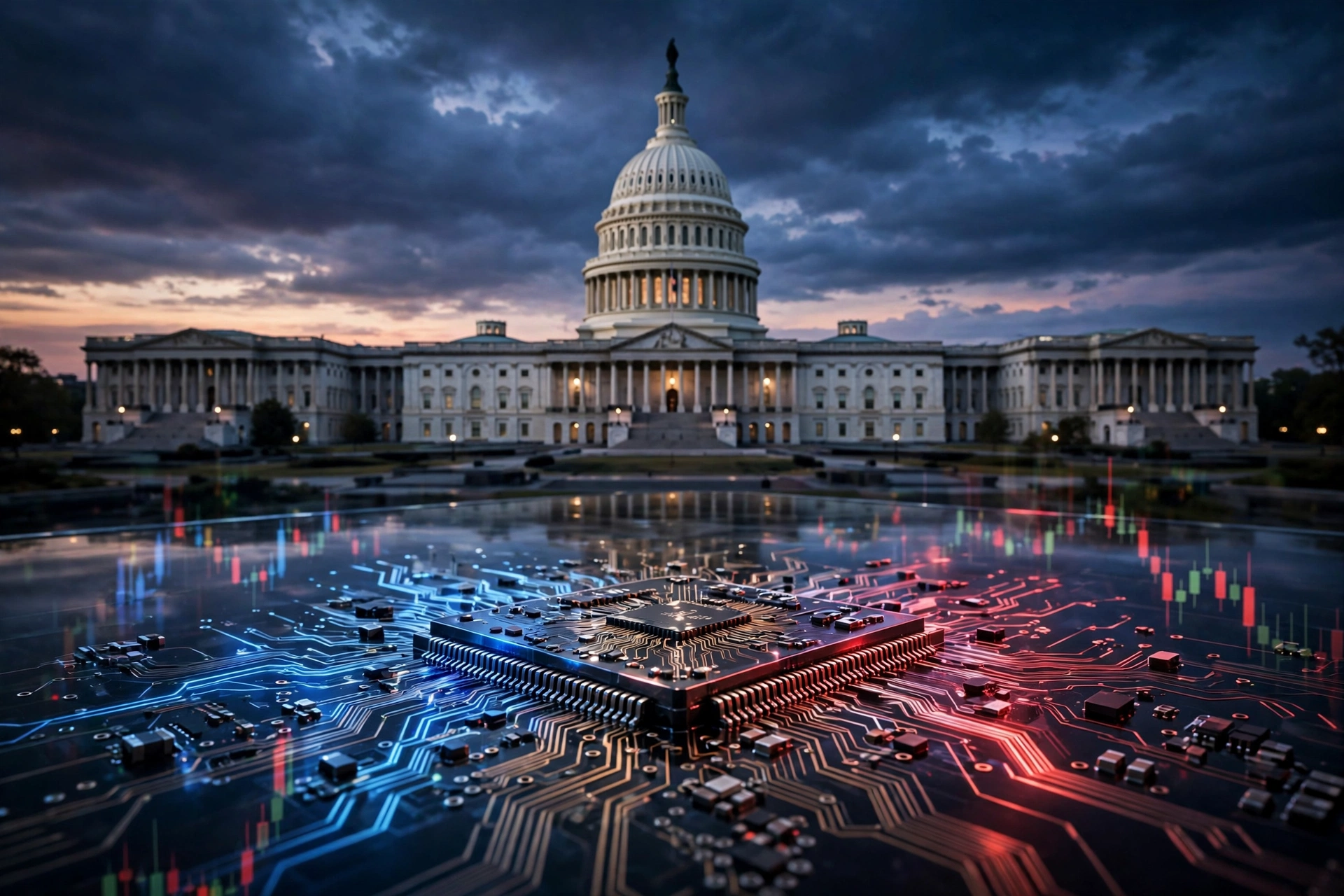
The first stocks to react to Tuesday's US midterm elections may not trade in New York at all. Strategists mapping the vote in a Bloomberg scenario analysis have named Taiwan Semiconductor Manufacturing (TSMC), Samsung Electronics and SK Hynix among the shares most exposed if Democrats sweep Congress — because a new Congress could tighten scrutiny of the AI industry, data centres and the power bills behind them.
What is happening?
Americans vote on Tuesday, November 3, for all 435 seats in the House of Representatives and 35 seats in the Senate. Republicans currently hold the Senate 53-47 and the House by a narrow 218-214 margin, so Democrats need a net gain of four Senate seats and three House seats to control both chambers, according to Longbridge's week-ahead calendar, compiled from Wallstreetcn. Prediction markets disagree on the exact odds but agree a Democratic sweep is the single most likely outcome: the forecaster Call the Map put it at 57% on October 31, with divided government at 28% and a Republican sweep at 15%, while betting markets cited by Wallstreetcn price a Democratic sweep higher, at 67%.
Scenario 1: A Democratic sweep puts AI scrutiny on the table
In the sweep scenario, Bloomberg's strategists expect stricter congressional scrutiny of AI and data-centre construction, including pressure for developers to bear more of the cost of powering data centres, and stronger oversight of trade and technology policy. The Asian names flagged as potentially under pressure are TSMC, Hon Hai, Quanta Computer and Delta Electronics in Taiwan, Samsung Electronics and SK Hynix in South Korea, and Advantest in Japan, according to BigGo Finance's summary of the Bloomberg analysis. Phillip Wool of Rayliant Global Advisors warned that anything posing a threat to AI would deal a heavy blow to market sentiment in South Korea, Taiwan, Japan and, to some extent, China.
There is a built-in buffer: the president can veto legislation, and overriding a veto needs two-thirds of both chambers. Analysts therefore expect hearings and investigations, rather than immediate new laws, to be the first channel — but even that can slow orders and valuations across a supply chain that builds most of America's AI hardware.
Scenario 2: Republicans hold — continuity, with an oil warning
If Republicans unexpectedly keep Congress, strategists see policy continuity that could benefit Taiwanese and South Korean chipmakers and other suppliers to the US tech boom. BNP Paribas analysts added that existing defence-spending priorities would be more likely to continue, which could help Japanese defence and industrial companies. The catch is energy: Nagomi Capital's Kazuyuki Muramatsu warned that President Trump has hinted US strikes on Iran could resume after the vote, and that oil climbing to $120 a barrel could overshadow any post-election rally. That is not far away — the January Brent contract settled at $113.43 on Friday, up about 2.4%.
Scenario 3: Divided government — lower yields, softer dollar
A split Congress, the second-most likely outcome, could restrain fiscal expansion and push US Treasury yields down, indirectly supporting stocks, according to Lombard Odier. Commonwealth Bank of Australia strategist Carol Kong holds a similar view: Democratic control of Congress would compress room for fiscal expansion, ease upward pressure on US rates and weigh on the dollar. Westpac's Richard Franulovich added that a Democratic sweep could reverse the dollar's recent rally, and cautioned that a close result leading to recounts or legal challenges could shake confidence.
Why is this blowing up now?
Asia has more at stake in the AI buildout than any other region: Taiwan and South Korea supply a large share of the advanced chips and hardware inside US data centres. Aberdeen Investments' Pruksa Iamthongthong argues those chipmakers remain indispensable and that well-positioned players can weather different outcomes, while OCBC's Afdhal Rahman notes that any US shift on AI infrastructure, data centres or technology restrictions would reverberate through Asian supply chains. The debate has landed just as Asian markets open a new week still digesting October's AI selloff, and in the same week as Apple and AMD earnings and Friday's US jobs report.
What's next?
History offers one calming statistic: Wells Fargo notes the S&P 500 has risen in the 12 months following every midterm election since World War II, and Carson Investment Research data show US stocks have averaged gains under every congressional mix since 1950 — 13.7% a year under a Republican president with a divided Congress. The result itself may matter less than what follows: watch the final Senate count, and whether the new Congress moves on data-centre power costs and AI oversight. That, strategists say, decides whether this is temporary noise or the start of a new regulatory cycle for the AI trade. This article reports the scenarios; it is not investment advice.
FAQ
When are the US midterm elections?
Tuesday, November 3, 2026. All 435 House seats and 35 Senate seats are being contested, and US markets stay open.
Which Asian stocks are named as most exposed to a Democratic sweep?
TSMC, Hon Hai, Quanta Computer and Delta Electronics in Taiwan, Samsung Electronics and SK Hynix in South Korea, and Advantest in Japan, per Bloomberg strategists summarised by BigGo Finance.
What do prediction markets expect?
Call the Map put a Democratic sweep at 57%, divided government at 28% and a Republican sweep at 15% on October 31; betting markets cited by Wallstreetcn price a Democratic sweep at 67%.
Have stocks historically risen after midterms?
Yes — Wells Fargo notes the S&P 500 has risen in the 12 months after every midterm election since World War II, though past performance never guarantees future returns.